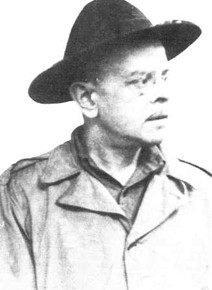
 Today’s edition of NtHWS Extras brings us the amazing tale of Dr. Gordon S. Seagrave, arguably one of the most selfless and impressive American expatriates of the 20th century. There is nary a peep about Seagrave in Now the Hell Will Start, primarily because he’s not the sort of bloke you can just casually mention without giving some backstory; if we’d brought up his saintly endeavors, we would have been compelled to spend pages on the topic. So the good doctor fell by the wayside—until now.
The son of Baptist missionaries, Seagrave spent 44 years tending to the medical needs of Burma’s hill tribes. Time caught up with the doctor in 1961, just four years before his death:
Seagrave’s main hospital building is a substantial stone structure which he helped build with his bare hands to show native laborers that Americans do not consider manual work demeaning. The other buildings are of flimsier native construction. Thanks mainly to a U.S. support group, American Medical Center for Burma, Inc., which raises funds, and to drug manufacturers who donate supplies, Dr. Seagrave is able to practice and supervise good medical care for a population of border tribesmen totaling some 400,000. He fills 250 beds and 50 mats with about 2,500 admissions a year for surgery and an equal number for medical treatment, plus 10,000 out patient visits. He also runs one of the best Western-style nursing schools of any of the underdeveloped countries.
The Burma surgeon does all this on less than a shoestring, but then he always has.
He got started with a wastebasketful of broken surgical instruments that he salvaged from Johns Hopkins Hospital. The hospital’s yearly budget is $75,000— a third of what Seagrave needs. He takes only $90 a month as salary and pays for his own food out of it.
Dr. Seagrave, who no longer visits the U.S., vows to die in Burma. He tires easily; he has heart trouble—despite which he is a chain smoker.
During World War II, Seagrave was forced to flee the Japanese invasion of Burma. He joined Lieut. Gen. Joseph “Vinegar Joe” Stilwell in his famous march out of Burma, along with 19 of his nurses. Five years after the end of the war, he was prosecuted for treason by the newly independent Burmese government; the main charge was that he aided Karen rebels, who continue to fight to this day. Seagrave got off thanks to international pressure, and spent the next 15 years back at his hospital in Namkhan. Per his wishes, he died there in 1965.
Seagrave is such a towering figure due to his utter indifference to his own happiness. Despite his missonary roots, he was no Baptist proselytizer; rather, his passion was tackling the challenge of making something out of a nothing, again and again and again. And in the poverty-stricken wilds of Burma, where the monsoons exact an awful annual toll, the cycle of reinvention is perhaps the only constant.
More on Seagrave’s wartime work here. Seagrave’s own book, Burma Surgeon, has long been out of print, but is a staple of dusty university libraries. Microkhan may just have to dig up a copy at his current Columbia Library headquarters.

Rick Ewing // Jan 12, 2012 at 10:22 am
My father Captain Noah Ewing was an American liaison officer with the Chinese army. He told me he sailed to the orient with Dr. Seagraves on a ship named the USS Mariposa; and that they became friends. After 2 years in the jungle he said he met with Dr. Seagraves again, in Calcutta. My father was ravaged with malaria and other maladies for which Dr. Seagraves saw to it that he was hospitalized. I can remember an episode of the television series “the 20th” Century” chronicling Dr. Seagraves great work.
Brendan I. Koerner // Jan 12, 2012 at 3:15 pm
@Rick Ewing: Thanks so much for sharing the memory from your father. Seagrave was, indeed, an incredible man.
N Curtis // Jan 25, 2012 at 12:57 am
I came across a copy of Burma Surgeon as a teenager in 1967 or1968. I was enthralled. Went to medical school because of this inspiration (now work in international child health field).
Brendan I. Koerner // Jan 25, 2012 at 8:59 pm
@N Curtis: Amazing. Thanks a mil for sharing. I’m sure you’re not the only one who was inspired by Burma Surgeon.
saikyawnaingoo // Feb 27, 2012 at 6:47 am
thankyou
shwe myint // Jun 5, 2012 at 12:23 pm
Salute to Dr.G.Seagraves and nurses who saved the life of soldiers retreating from Burma jungles to india during world war 2 and his contribution to Burma health systems and health workers.
With great respect and love
shwe myint(ordinary radio broadcaster,Australia)
06.06.2012
Robin // Aug 1, 2012 at 10:07 pm
One of our professor’s, Dr. Robert “Bob” Bullock, who passed away July 31, 2012, is mentioned in Seagrave’s book, Burma Surgeon.
Bob wanted to be a surgeon but wasn’t able to because he was color blind. Instead, he earned a doctorate in entomology and served the world renowned Florida citrus industry, where is he remembered as a great man who selflessly made a lifelong commitment to citrus industrymen, among other causes, one of which was Jesus Christ.
I can see it in his lifetime, the influence of Dr. Seagrave. It’s beautiful. He was a man bigger than most, full of honor and charity, benevolence. He was inducted to the Florida Citrus Hall of Fame, among other achievements.
Brendan I. Koerner // Aug 2, 2012 at 9:13 am
@Robin: Many thanks for the kind remembrance. I am amazed that this post continues to attract comments over three years since it went up–a testament, of course, to Dr. Seagrave’s impact on so many lives.
Steve Campbell // Feb 3, 2013 at 6:28 am
There is a Chinese/Burmese doctor, Fu Chin Lee, here in my home town of Bendigo, Australia who, as a young medical student, was invited by Seagrave, to have lunch at his home in Namkhan. This was just prior to him departing for London to begin his medical studies. Seagrave’s wife made apple pie. He said it was the first time he realised that apples could be cooked!
NWE NWE // Jul 21, 2013 at 7:34 am
My mother was Chit Sein, Miss Burma 1942.
My mother passed away in 1971.
My mother and Maru Bauk were life long friends.
I am very proud of my mother’s contributions
in nursing patients.
Min Thet Naing // Apr 7, 2014 at 11:48 am
My grandmother works under Dr. Seagraves
long time. Im very pround of my grandmother.
Lilly // Nov 29, 2014 at 10:08 am
I met his adopted Burmese daughter family …It was a blessing…
dennis carver // Dec 15, 2014 at 1:09 am
My father helped build the roads while in the US Army ’42-’44 that became the Stillwell and Burma Roads, mentioned constantly in “The Burma Surgeon Returns”. I re-read Seagraves books periodically, since my father’s wartime work was so closely parallel to Seagrave’s. I hope to visit north Burma this coming year.
Nicholas Wong // Feb 19, 2015 at 11:11 pm
My grandfather was Dr Horace Yu, who makes a few cameo appearances in Burma Surgeon. Dr Yu lived on until 1995 and never officially retired. Like Seagrave he worked like a warhorse but dedicated himself to his patients.
M. Harper // Dec 30, 2015 at 7:30 pm
My husband’s great uncle was Dr. Robert Harper mentioned in Dr. Seagraves book. I fist heard about Dr. Harper at a family reunion in Ireland. I found a copy the the Burma surgeon and was inspired by all that this man accomplished and amused by his discription of our great uncle.
M. Harper // Dec 30, 2015 at 7:32 pm
My husband’s great uncle was Dr. Robert Harper mentioned in Dr. Seagraves book. I first heard about Dr. Harper at a family reunion in Ireland. I found a copy the the Burma surgeon and was inspired by all that Dr. Seagrave accomplished and amused by his discription of our great uncle.