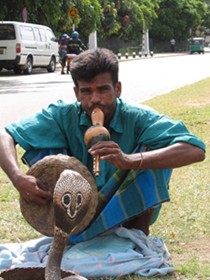
 As if the Pakistani government wasn’t already catching enough flak for its inefficacy, now some learned herpetologists are criticizing its lackluster approach to rounding up poisonous snakes:
A report jointly prepared by Snake Research Academy (SRA) and University of Sindh, Jamshoro (SUJ) has slammed the snake catching methodology of the National Institute of Health Sciences (NIHS), Islamabad.
The authors of the report, Prof. Dr Ghulam Sarwar Gachal of SUJ and Snake Research Academy (SRA) Project Manager Tanveer Ahmed Shaikh, had both recently undertaken a visit to NIHS to observe the methodology of extracting venom employed, and to initiate interaction and exchange expertise to save snake species. However, they returned with unfavorable impressions.
They said that Sindh contributes 2,000 venomous snakes annually to fulfill the entire NIHS requirement of extract venom to manufacture anti-snake bite vaccines (ASVs). To achieve this purpose, NIHS had hired traditional snake charmers to catch poisonous reptiles from the wild and hand it over to them. The two researchers however maintained that this was an unscientific methodology for extracting venom.
The report said that when the researchers observed NIHS officials extracting venom, they realised that the methodology being employed was traditional and unscientific. The researchers alleged that NIHS personnel extract venom from the snakes after every 15 days, and continue doing so till the reptile dies.
It is worth remembering here that NIHS produces between 30,000 and 32,000 vaccines annually. Each vaccine contains 10ml, and is sold at a fixed price of Rs700.
The report warned that if the NIHS continues to apply its method of catching poisonous snakes and killing them for extracting venom, Sindh will be deprived of its natural species within three years.
Actually, our vague familiarity with the world of antivenin production makes us question the Pakistani researchers’ critique. Venom extraction has been altered little by the advent of new technology; even in the most advanced settings, the process still basically consists of manually forcing fangs onto a glass dish. (Video here.) On top of that, the 15-day waiting period is within the guidelines employed by American zoos, who recommend that venom be allowed to accumulate for between 14 and 30 days.
As merely hinted at later in the article, the problem actually seems to be the black market. Those snake charmers are apparently abusing their licenses and siphoning off venom for sale to health-care institutions (or individual victims) priced out of the government-run antivenin bank. American proponents of drug reform, take note—we foresee a similar scenario coming to fruition should the California marijuana model go nationwide. Regulation (particularly price control and taxation) is a tricky beast when the product in question can be manufactured for a relative pittance.

Jordan // Sep 17, 2009 at 4:12 pm
Tragedy of the commons? I guess the question is how much their prices would have to go up to make it a catch-and-release type program instead of milking the snakes for everything they can.
Brendan I. Koerner // Sep 18, 2009 at 11:05 am
@Jordan: It’s tough to say, given that the article is so terribly written. (Perhaps it was translated?) Not entirely clear whether the charmers are siphoning off a little black-market venom before handing over their catch to the government, or whether they’re just using their licenses to keep snakes themselves.
Either way, one thing is clear—I’m glad I’m not involved in this line of work.
The Venom Trade, Cont’d // Sep 18, 2009 at 12:18 pm
[…] yesterday’s post on Pakistan’s troubled system of snake-venom collection, we opined that technology seemed to have changed the field little. But if we’d read the […]
More on the Venom Trade // Sep 21, 2009 at 12:27 pm
[…] one of our recent posts regarding the troubled Pakistani snake-venom industry, we opined that government price controls were making the black market too appealing for Sindh […]
Md.Rajibur Rahman // May 19, 2010 at 7:16 am
Hi, I”m rajib.I”ll make a snake Farm in Bangladesh.For snake-venom.Please give me some information .because its first time in our Bangladesh.(rajiburrahman60@yahoo.com)
Muhammad Shoaib // Nov 9, 2010 at 2:42 pm
Dear All,
i am in process of making legal breeding centre for snakes in Pakistan. Hopefully in coming months i will be able to breed snakes in my centre for extraction of venom. feel free to contact me.
m.sh004@gmail.com
+923454013136
doru alexandru // Feb 14, 2011 at 9:23 am
PHARMA VIP
(farm of vipers)
http://www.ferma-de-vipere.ro
ofertavenin@ferma-de-vipere.ro
PHARMAVIP ROMANIA, manufactures and markets under international law, the viper venom of the species ammodytes ammodytes. ( Vipère des sables (F); Nose-horned Viper (E) ; Species Authority : Linnaeus, 1758)
The company has as object of activity the growth of vipers especially those from the species Vipera ammodytes ammodytes, for production and collection of venom.
The venom so obtained is processed into lyophilized form at the National Institute of Research and Development for Microbiology and Immunology “Cantacuzino”, Bucharest.
The finished product is analyzed in terms of organoleptic, physico-chemical and protein profile at the National Institute of Chemical-Pharmaceutical Research and Development in Bucharest.
-protein content (Lowry) 96,3%
-vammin 9,705.40 mass (9,704.40 TOF)
-ammodytin 13,729.67 mass (13,728.67 TOF)
-residual humidity < 2%
-purity 99%
-DL50 = 1,88 mg/kg
The finished product is tested for radioactive contamination by the National Institute of C & D for Physics and Nuclear Engineering Horia Hulubei in Magurele-Ilfov.
Now we produce 20 grams of lyophilized venom every month, but we can go up to 80 grams per month if we get a long term contract.
In stock we have a quantity of 300 grams of lyophilized venom.
Venom is bottled in vials of 3 grams and 5 grams.
Sale price is 800 Euros per gram.
PHARMAVIP Romania is dedicated to building and holding long-term business relationships.
CONTACTS :Our webpage is http://www.ferma-de-vipere.ro , email: ofertavenin@ferma-de-vipere.ro , mobile:+40740176421 ; +40768120051 ; +40768120050
with consideration
ing. Orcula Doru Alexandru
H.M.Hossain // Nov 2, 2011 at 12:03 pm
>I am snake specialist in Bangladesh. i can rearing snake and extraction snake venom. i am fully expert in this lines and I have written a book on snake and its available in market. those are interested to establish snake farm in Bangladesh please contact with me., I have 25 years practical experience in this connection .H.M.Hossain. email-panasiabd@gmail.com. mobile-008801711524343
Md. Rajibur Rahman // Feb 8, 2012 at 12:26 am
“I am snake specialist in Bangladesh. i can rearing snake and extraction snake venom. i am fully expert in this lines and I have written a book on snake and its available in market. those are interested to establish snake farm in Bangladesh please contact with me., I have 25 years practical experience in this’
Dear Hasan Vai,
after read your post i interested you And your plan. Please contract With Me rajiburrahman60@yahoo.com/01717327050
belal hossain // Jul 23, 2015 at 6:05 am
Md. Rajibur Rahman i interested you and your plan. apni ki vhi snake farm diachen?